Why Is the Ocean Blue? The Science Behind the Color of the Sea
Have you ever looked at the ocean and wondered why it appears blue? On a sunny day, the sea can look bright turquoise near the shore and deep blue farther away. Sometimes it appears green, gray, or almost black.
These changing colors are not just beautiful to look at. They reveal interesting facts about how light interacts with water, the atmosphere, and tiny particles in the ocean.
Let’s explore the science behind the ocean’s color and discover why the sea does not always look the same.
1. Water Absorbs Some Colors of Light More Than Others
Sunlight appears white, but it contains a mixture of different colors, including red, orange, yellow, green, blue, and violet.
When sunlight enters water, some of its energy is absorbed. Water absorbs longer wavelengths, particularly red and orange light, more strongly than blue light. As light travels deeper, much of the red light disappears while more blue light remains available to be scattered or returned toward our eyes.
This selective absorption is one of the main reasons large bodies of relatively clear water often appear blue.
2. The Ocean Is Not Blue Only Because It Reflects the Sky
A common explanation is that the ocean looks blue because it reflects the blue sky. Reflection does contribute to the appearance of the sea, but it is not the whole story.
Even under different sky conditions, sufficiently deep and clear water can still appear blue. This happens because water itself absorbs and scatters light differently depending on its wavelength.
The sky’s reflection becomes more noticeable when the sea surface is smooth and mirror-like. When the surface is rough, reflections become more scattered, making the ocean’s appearance more complicated.
3. Shallow Water Often Looks Turquoise
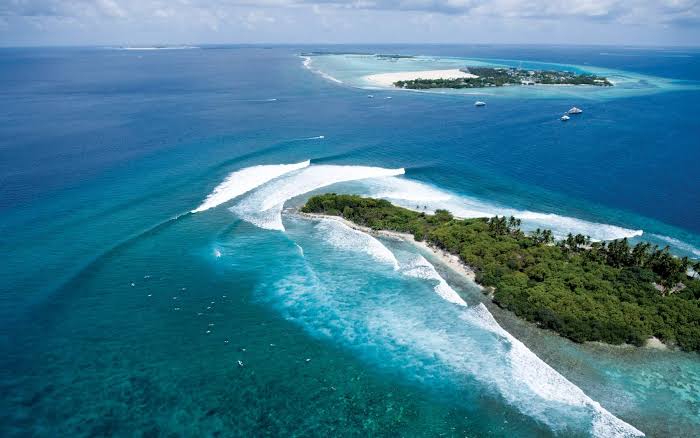
Have you noticed that tropical beaches often have bright turquoise water? One reason is that shallow water allows light to interact with the seabed.
When sunlight reaches pale sand or coral beneath clear, shallow water, some of the light reflects upward. Combined with the water’s absorption and scattering properties, this can produce attractive shades of turquoise and light blue.
The depth of the water, the color of the seabed, and the amount of suspended material all influence the final appearance.
4. Tiny Particles Can Make the Ocean Look Green
Not all ocean water is blue. In some areas, it appears green because of microscopic organisms, suspended particles, and dissolved substances.
Phytoplankton are tiny organisms that live in the ocean and use sunlight for photosynthesis. Many contain chlorophyll, a pigment that absorbs certain wavelengths of light. In areas with abundant phytoplankton, the water may appear greener.
Sediment from rivers, coastal erosion, and waves can also change the way light moves through the water, affecting its color and clarity.
5. Deep Ocean Water Can Look Dark Blue
Open ocean water often appears darker blue than shallow coastal water. In deep water, light travels through a much greater volume of water, allowing more of it to be absorbed before it returns to the surface.
When the water contains relatively few suspended particles and phytoplankton, its deep blue appearance can be especially noticeable.
Under cloudy skies, at low light levels, or in areas with strong shadows, the same water may appear gray, navy, or nearly black.
6. Sunlight and Weather Change the Ocean’s Appearance
The ocean’s color can change throughout the day because the angle and intensity of sunlight change. Bright midday sunlight may make the water look vivid, while early morning and evening light can give it warmer or darker tones.
Clouds reduce direct sunlight and can make the sea appear gray. Wind creates waves that reflect light in different directions, while calm water may produce clearer reflections of the sky.
These effects explain why the same beach can look completely different at different times of day.
7. Scientists Use Ocean Color to Study the Earth
Ocean color is more than a visual feature. Scientists use satellite observations to estimate properties of surface water, including the concentration of phytoplankton and the presence of certain suspended materials.
These measurements help researchers investigate marine ecosystems, track changes in ocean productivity, and study environmental conditions across large areas.
Satellite ocean-color measurements are estimates rather than direct measurements of every organism or substance in the water. Scientists use additional observations and validation methods to interpret them accurately.
Why Does the Ocean Sometimes Look Brown?
Brown or muddy-looking water often contains high concentrations of sediment. Rivers can carry soil and other particles into coastal waters, especially after heavy rainfall. Waves and currents can also stir up material from the seabed.
In some locations, dissolved organic matter released by plants and decaying material can give the water a yellowish or brownish color.
A change in color does not automatically mean the water is polluted. However, unusual changes, floating waste, or strong unpleasant odors may indicate an environmental problem that deserves further investigation.
Final Thoughts
The ocean’s color is the result of several interacting factors. Water absorbs different wavelengths of sunlight at different rates, while scattering, reflections, depth, particles, and marine organisms also influence what we see.
That is why the sea can appear deep blue in the open ocean, turquoise near a tropical beach, green in areas rich in phytoplankton, or brown near sediment-filled river mouths.
The next time you look at the ocean, remember that its color is a visible clue to the complex interaction between sunlight, water, and the environment.
Frequently Asked Questions
Is the ocean naturally blue?
Clear ocean water often appears blue because water absorbs longer wavelengths of light more strongly than blue wavelengths. Scattering and reflection also influence its appearance.
Why is seawater turquoise near beaches?
Shallow water, pale sand or coral, and the way sunlight interacts with water can produce turquoise colors near beaches.
Why does the ocean look green sometimes?
Phytoplankton, suspended sediment, and dissolved substances can change how light is absorbed and scattered, making the water appear green.
Does the ocean reflect the sky?
Yes. The ocean reflects some light from the sky, but its blue color also results from the optical properties of water itself.
Why is deep ocean water darker?
Light is progressively absorbed as it travels through water. In deep areas, less light returns to the surface, often making the ocean appear darker blue.